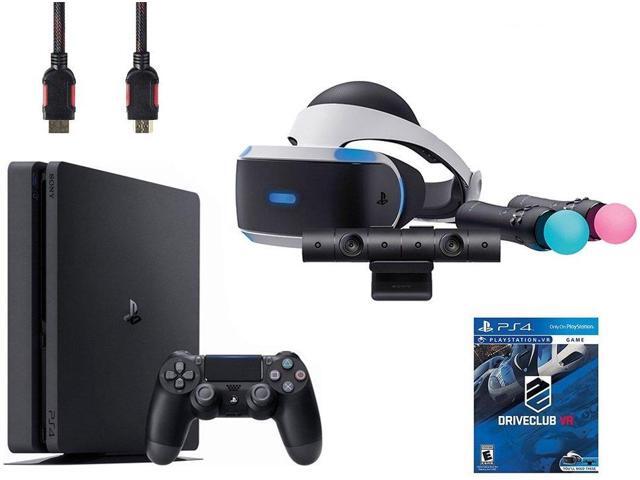
Driveclub Vr Motion Support
Comments
- I've just asked a local game journalist that had the opportunity to test this, and the news are quite disturbing/worrisome:
There is motion blur.
It suggests that the low persistence requirement of equal framerate and refresh rate, might be in effect.
Or it's an 'artistic decission', but I don't think that Evolution Studios would be that stupid to add motion blur to a game displayed at low persistence OLED display. I tested that many times and it's obvious that on a good display that handles the image in motion in razor-sharp quality, motion blur enabled makes the game uglier and less enjoyable (sense of speed). No matter what game genre and how advanced the motion blur is.
Even more so in 120fps/120Hz.
If that's the case with this VR DriveClub prototype, then I want to point out that Sony enabled the PSVR to run at three framerates:
60fps with time warping techniques etc. for 120fps @120Hz
90fps @90Hz
60fps @60Hz (unconfirmed as of yet)
but I'm afraid developers will choose 60fps over 90fps from the same stupid/marketing reasons as the case with choosing 30fps over 60fps in 2D games.
As always: I hope I'm wrong.Not an Oculus hater, but not a fan anymore.
Still lots of respect for the team-Carmack, Abrash.
Oculus is driven by big corporation principles now. That brings painful effects already, more to come in the future. This is not the Oculus I once cheered for. - There's nothing stupid or 'marketing' about targeting 60fps when you've got a 120hz display and reprojection ability.
Also, where did you talk to this dev? - Oh man, not you again..
I'll answer anyway:
1. IF it's not an art choice made by the developer, It's stupid to go for better graphics for marketing instead for 90Hz for gameplay quality. I understand how slow PS4 is in terms of VR, but it's just a matter of graphics simplicity. There are truly 120fps games in a form of fully funcional betas, demonstrated already to the public, PSVR supports 60, 90, and 120fps.
Although they have graphics on the PS2 level or even lower, it proves that it can be done.
2. I asked on a local gaming website run by the biggest gaming magazine in my country. The guy replied for my question about the blur and said there's certainly SOME blur. If low persistence would work, there would be absolutely no blur. I have almost crystal-clear image at 120Hz on my TN LCD monitor that have low persistence (backlight strobing with vast strobing control through Blurbuster Utility) so OLED panel should have no problems.
On the other hand, double strobing is a function I had to disable by installing a new firmware, so I could get the control over double strobe switch. In games displaying constant and stable 60fps, the image is AWFUL in any refresh rate that is not 60Hz. Even 120. Look really, really bad. Almost no advantages of low persistence left. Unacceptable to the point I prefer to play short sessions at 60Hz, which is flickery as hell.Not an Oculus hater, but not a fan anymore.
Still lots of respect for the team-Carmack, Abrash.
Oculus is driven by big corporation principles now. That brings painful effects already, more to come in the future. This is not the Oculus I once cheered for. - Some motion blur is good, like at 1/60th speed.. faster than that just looks choppy/nervous IME
This game is already known for that smooth 'dreamy' quality. Of course they wouldn't take it out completely. - Does the reprojection alter the image in any way or is it simple the same frame? If it does then that could be a possible cause of motion blur. They can't seriously be stupid enough to enable motion blur for Vr. 90hrtz native will always be fair better then 60fps at 120hertz. As far as I know sony have disabled 60fps at 60hertz.
The problem I have for motion blur of any kind is that it doesn't exist in real life, only at extremely high speeds. It's just copied to recreate a cinema experience.Visit my amateur homegrown indie game company website!
http://www.gaming-disorder.com/ - It tries to create an in-between frame by morphing one image to the next, like tweening in animation or those sometimes horrible looking fake slow-mo techniques:
https://www.youtube.com/watch?v=M_LE96nGqik
of course the difference is they play it back at 100% speed, and most artifacts go unnoticed, I guess..
Like that Twixtor software shown above it is possible to separate foreground and background, and some other techniques, to help reduce artifacts. Not sure if they do that in this case, but it's a pretty popular/common thing nowadays.
That must mean extremely high speeds don't exist in real lifeit doesn't exist in real life, only at extremely high speeds.- Haha yeah, that was so badly written. I meant your eyes will naturally do motion blur so it doesn't need to be added in virtual life.
So maybe the frame altering is worst in fast forward motion games. Rotation is less noticeable because the scene is closer to being the same.Visit my amateur homegrown indie game company website!
http://www.gaming-disorder.com/ - Some motion blur is good, like at 1/60th speed.. faster than that just looks choppy/nervous IME
This game is already known for that smooth 'dreamy' quality. Of course they wouldn't take it out completely.
You didn't research the matter of low persistence gaming a lot, did you? Not to attack you or anything, but it's a tricky, difficult and deceiving matter with lots of traps most people fall into.
I've put a lot (too much ) time into this to learn the phenomenon well and my conclusion is this: Starting from 60fps, any motion blur is bad. On the one side of the scale, you have that 'smoothness', but on the other side you have something much more valuable - crystal-clear image, lots of details. And the sense of speed is very good at 60fps even without any blurs.
Now, when you jump to 120fps @120Hz, you get both the image clarity and that butter-like smoothness.
Well, actually it depends on the speed. Slow cars = 60fps is 100% sufficient. Faster? 90fps becomes the limit to 'have it all'. Supercars? 120fps recommended. But.. there are also future racers with speeds above 800KPH. This case would even benefit from 180fps @180Hz display.
Shadowfrogger
That's great. Less chance that VR gaming market gets flooded with content from mobiles. Bigger chance someone will create VR videos in 90 or 120fps instead of all going for 60.As far as I know sony have disabled 60fps at 60hertz.Not an Oculus hater, but not a fan anymore.
Still lots of respect for the team-Carmack, Abrash.
Oculus is driven by big corporation principles now. That brings painful effects already, more to come in the future. This is not the Oculus I once cheered for. - I have the Sony TV when it first made 240Hz. Enabling smoothness in the settings made all low FPS and video feel like 240Hz but I think it adds a slight delay in the picture so it adds all the frames together then releases the interpolated frames. I'm not sure how it does it but it did make it smoother. The new Sonys and TV's don't have the feature for some reason. GT5 on PS3 was smoother with it enabled.
It was the Sony 46HX800 I think.
I was using it for a monitor for a while but because of the HDMI input lag DVI-D is far superior. Then Gsync came along and made it even more responsive and smoother.
Sony knows something that the world doesn't but they didn't really market it. I think some other TV's had the smoothness too but I never owned them. Walking through Sears and looking at the TV's back then had some smoothness but then I was looking at newer premium TV's and they weren't smooth but cost $3k+.0 - If that's the case with this VR DriveClub prototype, then I want to point out that Sony enabled the PSVR to run at three framerates:
60fps with time warping techniques etc. for 120fps @120Hz
90fps @90Hz
60fps @60Hz (unconfirmed as of yet)
but I'm afraid developers will choose 60fps over 90fps from the same stupid/marketing reasons as the case with choosing 30fps over 60fps in 2D games.
As always: I hope I'm wrong.
AFAIK the 60hz mode is always with reprojection on. And you forgot the 120hz/fps mode.
PD. I don't think they're stupid.
VR games may cause some players to experience motion sickness. This PlayStation®VR demo sampler includes demos of entertainment and gaming content spanning across a wide variety of diverse genres. Here’s what you get:. Allumette (Penrose). 4. Battlezone (Rebellion). DriveClub VR (SIE WWS).
Speculation surrounding the delay of PS4 exclusive DriveClub suggests this was mainly due to the implement virtual reality support, but Sony Worldwide Studios president Shuhei Yoshida has recently discarded these rumours as just that.The discussion came up at the GDC 2014 where Yoshida confirmed to Gamespot that this was indeed a rumour, although he does admit to experimentation with the cockpit view with the help of Project Morpheus.